
Does the "Ghostverse" Exist?
Why physics does not exclude it and may even hint at it

In contemporary physics and cosmology the so-called “Multiverse” is the idea that our observable universe may be only one among many distinct universes, potentially differing in physical laws, constants, and dimensions. Different versions of the multiverse arise in different areas of physics and cosmology: in eternal inflation, quantum fluctuations continuously generate causally disconnected “bubble universes” or in some string-theoretic models, vast numbers of possible vacuum states correspond to different universes with different low-energy physics.1 Advocates argue that multiverse frameworks may help explain why the universe seems to be fine tuned for life, while critics contend that multiverse proposals are impossible to test empirically and thereby are branded as “metaphysics” or just “pseudo-science.” As a result, the multiverse remains one of the most controversial and philosophically charged ideas in modern theoretical physics.
I won’t go into the details of the this debate, since many people have already discussed it extensively. It has captured the imagination of the popular audience to such an extent that, in my view, it often receives more attention than it deserves. Instead, I would like to focus on another kind of reality that modern physics equally suggests and, I would argue, even more strongly points toward, yet which is rarely considered and deserves far more attention.
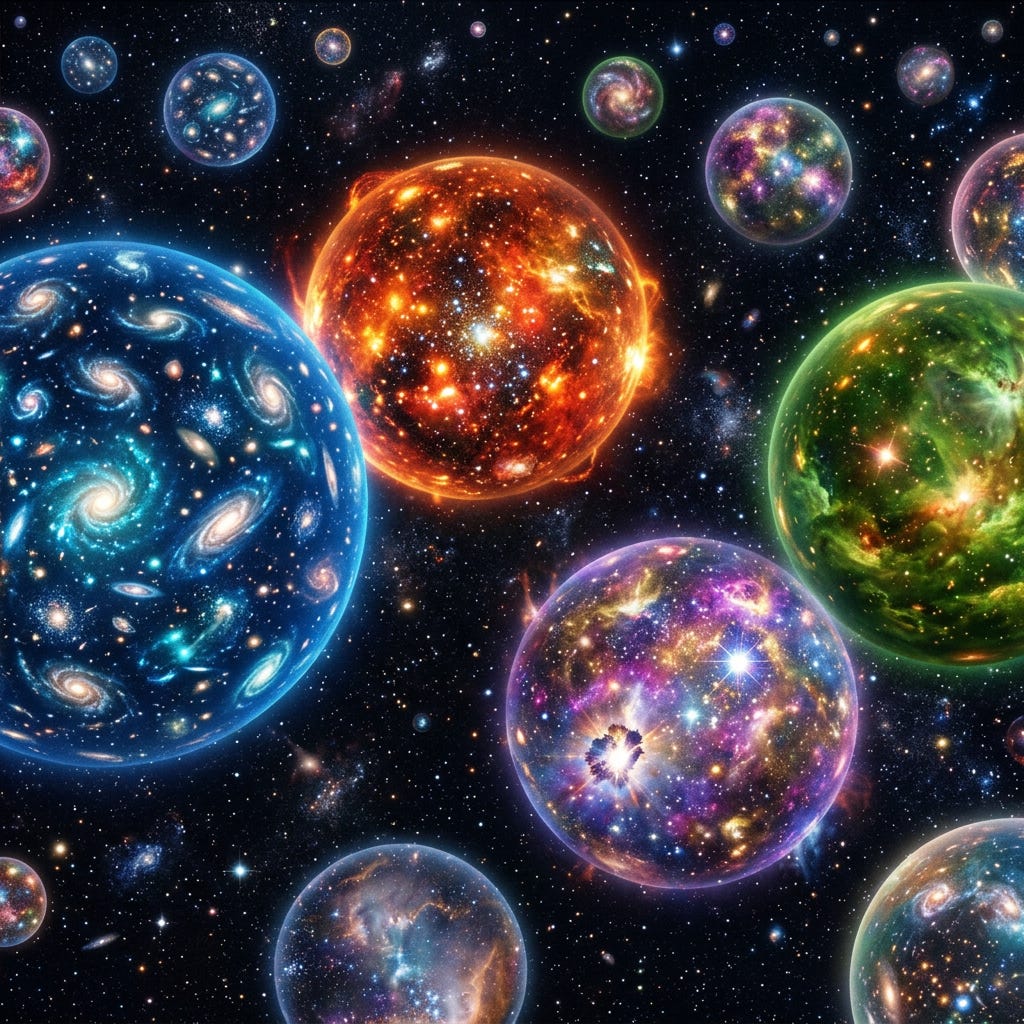
In these theories, one typically imagines other universes as being “out there,” separated and far removed from our own universe and from the reality we experience. Little attention is given to the fact that modern physics does not require elaborate and speculative extensions, such as string theory or other currently untestable quantum gravity frameworks, to suggest the existence of a kind of “parallel” universe. Modern quantum field theory, extensively confirmed experimentally in its present formulation as the Standard Model, already seems to imply the admissibility of a sort of “subtle” or “ghostly” universe contained within our own, here and now. Not a distant cosmic domain existing outside our spacetime, as in the image of separate and disconnected spacetime “bubbles”, but rather an invisible layer of reality somehow embedded within and intertwined with ours. Something so fine-grained and subtle that it almost does not interact with the kind of matter we perceive in our ordinary experience, yet nonetheless exists and may still interact weakly with what we call the “physical world,” potentially producing real and concrete effects at our own level of existence. Something that I would call a “ghostverse,” by analogy with the popular conception of ghostly entities.
Ghost are typically understood as the lingering presence or manifestation of a deceased person, often imagined as retaining some form of consciousness, memory, personality, or agency after bodily death on “planes of existence” independent of the physical body. Of course, nothing of this kind is currently accepted within mainstream science.2 However, the modern picture of physical reality comes much closer to this idea of additional “layers” or domains embedded within the material world than is commonly assumed.
One of the simplest historical examples to begin with, and one with which we are all familiar, is the fact that we are directly aware of only a tiny fraction of the electromagnetic spectrum. Visible light constitutes merely a narrow band within a much broader spectrum extending from radio waves to ultraviolet light, X-rays, and gamma rays. Today we no longer think of such phenomena as “ghostly” or “subtle,” but only because they have become integrated into our collective understanding through the use of technologies such as antennas, radios, cell phones, and countless other devices that made the imperceptible perceptible. Yet when Heinrich Hertz discovered electromagnetic waves in the late nineteenth century, they appeared mysterious and almost “ghostly” in nature. Hertz reportedly remarked: “We just have these mysterious electromagnetic waves that we cannot see with the naked eye. But they are there.” And these waves are not located somewhere else in a disconnected universe; they are here, permeating our environment and continuously passing through our bodies.
The reason we are not aware of most electromagnetic wavelengths is that they interact only very weakly with our sense organs, so that—with the exception of the visible spectrum—we cannot directly perceive them. Contrary to our intuition, the strength of an interaction between physical systems is not determined by its mass. Photons, the quanta of electromagnetic radiation, are massless, yet they carry energy and momentum and can interact with massive particles such as the electrons that constitute our bodies. This interaction is mediated not by “hardness” or material substance in a classical sense, but by a coupling strength between fields and particles.
In quantum field theory, this interaction strength is encoded in the electromagnetic coupling constant, commonly expressed through the dimensionless fine-structure constant, which determines the probability amplitude for interactions between charged particles and the electromagnetic field. The fact that photons are massless has no bearing on whether or how strongly they interact; what matters is the strength of the coupling between fields, not any notion of mechanical collision between solid objects. Or, to put it bluntly, the “spookiness” of a substance does not depend on its mass or density, but rather on the nature of the particles it is composed of and on how its fields couple to each other and to other particles. If the particles of one body interact strongly with those of another, primarily via electromagnetic forces between charged electrons, we describe them as “material” and perceive them as impenetrable objects made of hard stuff. That’s why one cannot walk through a wall. However, in a hypothetical world in which the fine-structure constant had a much smaller value, electromagnetic interactions would be far weaker. In such a regime, ordinary matter would be far less rigid, and it might even be possible to pass through what we now experience as solid objects without noticeable resistance. From our present perspective, matter in such a universe would appear almost “ghost-like,” not because it becomes immaterial, but because its interaction strength is drastically reduced.
More recent examples that shed further light on this state of affairs came from the infamous dark matter.3 What this dark matter is really about, and if it is material stuff at all4, nobody knows. Whatever it is, it has many ghost-like properties. We infer its existence because of its gravitational effects, even though it does not emit, absorb, or reflect light in any detectable way. It was introduced to explain several astrophysical observations, such as the unexpectedly high rotation speeds of galaxies, gravitational lensing effects in galaxy clusters, and the large-scale structure of the universe, all of which cannot be accounted for by visible matter alone. According to current cosmological models, dark matter makes up about 85% of the total matter content of the universe, yet its nature remains unknown.
Leading candidates include weakly interacting massive particles (WIMPs), axions, and other beyond-Standard-Model particles, although none have been directly detected so far. Massive but weakly interacting particles would correspond to heavy entities that could, in principle, pass through ordinary matter, including our bodies, without leaving any perceptible trace. If a particle does not couple to the electromagnetic, strong, or weak nuclear forces, then the only remaining interaction we know of through which it could reveal its presence is gravity, which is extraordinarily weak at the particle scale. In such a case, it would interact with the universe primarily through its gravitational field, while otherwise remaining effectively invisible to conventional detectors. It would traverse Earth and human bodies almost always without scattering like a perfectly collisionless fluid, yet embedded within the cosmic background and detectable only indirectly through highly sensitive gravitational or cosmological measurements.
However, as those familiar with the subject will know, the most “ghostly” particle we currently know of is the neutrino. Neutrinos are produced in vast numbers in nuclear reactions such as those in the Sun, in supernovae, or in radioactive decays, and they stream through ordinary matter almost completely without interaction. The mean free path—that is, the average distance a neutrino travels before scattering with another particle is enormous. Neutrinos can traverse the entire Sun and a planet like the Earth completely undisturbed. Hundreds of billions pass through your eyeball every second without any noticeable effect. Everything is almost perfectly transparent to them. In fact, the neutrino particle was first postulated by Wolfgang Pauli to resolve an apparent violation of energy and momentum conservation in beta decay processes. Beta decay is a type of radioactive decay in which an unstable atomic nucleus coverts a proton into a neutron while emitting a positron and a neutrino. Adding up the energy and momenta of the decay products did not add up with that of the initial state.
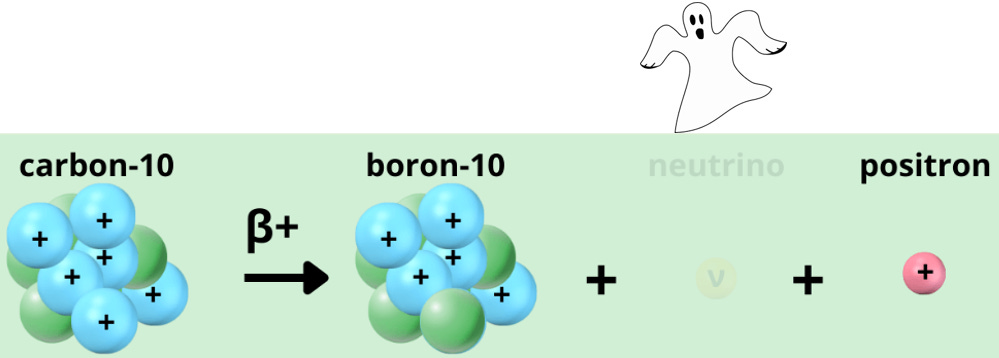
There are three types—or “flavors”—of neutrinos: the electron, muon, and tau neutrino, each associated with different mass states. What makes neutrinos even stranger is that they exist in a quantum superposition of mass eigenstates and can oscillate between flavors as they propagate through space. If this does not sound bizarre enough, imagine being in a superposition of being thin, overweight, and obese, and manifesting one of those states depending on where, when, and how you are observed. It is no coincidence that neutrinos came to be informally described as “ghost particles.”
Neutrinos are fundamental particles in the Standard Model having extremely small masses and no electric charge. However, again, the reason they are so extraordinarily difficult to detect has nothing to do with their small masses, it is rather the fact that they interact with other particles almost exclusively through the weak nuclear interaction which, as the name itself suggests, is … well, weak.
More generally, the “ghost-like” behavior of a physical entity has nothing to do with it being “non-physical,” nor is it fundamentally determined by its mass. Rather, it is a consequence of how weakly it interacts with other particles and fields.
In principle, one can conceive of massive material bodies traversing our own bodies here and now while remaining entirely invisible to us (and us to them) if their constituent particles do not interact, or interact only extremely weakly, through at least one of the four known fundamental interactions: the electromagnetic, gravitational, strong nuclear, and weak nuclear forces.
To the best of our current knowledge, there is no compelling evidence for the existence of a fifth fundamental interaction. Searches for additional forces beyond the four presently known ones have so far yielded no definitive results. Yet nothing in contemporary physics strictly guarantees that only four interactions can exist. In fact, modern particle theory actively explores such possibilities under labels like “dark sectors,” “hidden sectors,” “mirror matter,” “portal interactions,” etc. If there were other forces entirely unknown to us and, thereby, undetectable by our present instruments, it is conceivable that an entire domain of reality could coexist with the universe we ordinarily perceive. Such a realm might still be “material” in some sense, though governed by forms of interaction fundamentally different from the electromagnetic, gravitational, strong, and weak forces familiar to current physics. One could imagine a kind of “subtle physical” universe embedded within our own, coexisting with it , much like a system of Matryoshka dolls nested inside one another, while remaining largely inaccessible because its structure and dynamics are regulated by interactions to which ordinary matter couples only negligibly, or not at all.5

On the basis of all this, physics not only fails to rule out such a conjecture but, I would argue, even indirectly points toward its plausibility. The possibility of a kind of “ghostverse” seems, in a certain sense, already implicit within modern physics itself, especially within the framework of the Standard Model.
And if philosophers of mind, who so fervently debate how a supposedly “non-physical” mind could interact with a “physical” brain, were to update their conception of the physical world from a Cartesian 17th–19th century mechanical picture to the framework of contemporary physics, they might realize that it is not necessary to come up with contrived theories requiring violations of energy conservation or other physical laws in order to resolve these otherwise seemingly insoluble paradoxes, no more than it was necessary to invoke such violations to explain beta decay. There may be a far more interesting and conceptually fruitful way of approaching these deeper philosophical problems.
The subscription to “Letters for a post-material future” is free. However, if you find value in my posts and would like to support my work, please subscribe and recommend the newsletter to others, and make a small financial contribution by buying me one or more coffees. You can also support me by ordering one of my books or follow one of my online courses. Thank you in advance!
In the somewhat different context of the interpretations of quantum mechanics one finds also the Many-Worlds Interpretation (MWI): every quantum measurement branches into multiple coexisting “Worlds” each with its history. However, it’s better not to confuse the MWI with multiverse theories.
On the one hand, the physicalist will argue that there is no empirical evidence for such phenomena. On the other hand, one might point out that virtually any kind of “psi experiment” investigating so-called “paranormal effects” is dismissed or stigmatized from the outset within mainstream scientific inquiry. First, one refuses to seriously investigate the possibility; then one declares that no evidence exists. But I will not pursue that debate here, since it would distract from the point I am trying to make.
The same could be said about the equally enigmatic “dark energy,” the unknown form of energy that permeates space and is responsible for the observed accelerated expansion of the universe. I will set aside a detailed analysis of it here, since similar considerations apply as in the case of dark matter.
Some speculate that it may have nothing to do with “matter” in the usual sense at all, but instead reflect an apparent modification of gravitational dynamics on cosmological scales, as proposed in various Modified Newtonian Dynamics (MOND) frameworks. However, for the sake of argument, I will assume here that it corresponds to some form of yet-unknown substance.
One might object that there is an important caveat in this line of reasoning. The phenomena mentioned so far—electromagnetic radiation, dark matter candidates, and neutrinos—do not ordinarily form complex composite structures. They mainly appear as fluxes of particles and energy and, unlike ordinary matter, do not readily bind together into atoms, molecules, macroscopic objects, let alone living organisms. Yet this limitation may reflect only the boundaries of our present knowledge rather than a physical impossibility. Perhaps, unknown particles governed by interactions other than the presently known fundamental forces, and which could bind together analogously to how the electromagnetic and strong nuclear interactions allow the formation of atoms, molecules, and larger organized structures. Such possibilities are not excluded by the general conceptual framework of modern physics.
https://ruimpvieira.substack.com/p/the-formula-the-solar-system-almost
This was one of the coolest posts you've done in quite awhile. Wow!