
Does Anything Happen Without a Reason?
Afternoon Philosophical Ruminations at the Edge of Reason

The Principle of Sufficient Reason (PSR) is the philosophical idea that everything that exists, occurs, or is true must have a sufficient reason, or cause—that is, some explanation for why it is so rather than otherwise. Most closely associated with Leibniz and Spinoza, it states that no fact is ultimately inexplicable: every event has a cause, every truth some basis, and every existent a reason for its existence. The principle becomes controversial in contexts such as quantum mechanics, cosmology, and existential questions.
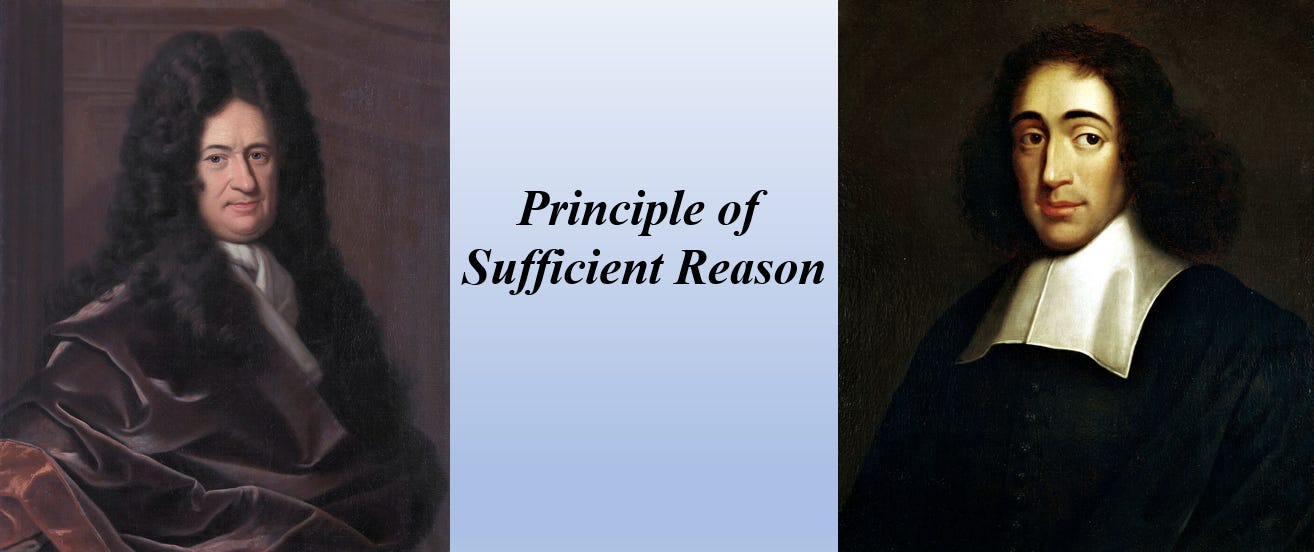
However, even in those contexts, I find it difficult to believe that something could occur without a cause, or that an event could simply emerge out of nothing. And I am not thinking only in terms of physical causation, but extending the principle to broader metaphysical domains as well. Even when one invokes a “God of the gaps” type of argument—that is, attempting to explain a phenomenon through God or some subtler paranormal agency—one is still reasoning in accordance with the PSR: the cause is not denied, but merely relocated from the physical to the metaphysical. The explanation becomes not “there is no reason,” but rather “the reason is that God did it.”
I would also agree with those who argue that there may exist facts that do not admit of a complete rational explanation. That seems plausible to me, since rationality is only a tool for understanding reality, not the ultimate instrument of knowledge itself. There may well be facts and forms of causation that transcend the explanatory frameworks of the analytic mind, perhaps even realities that are transcendent, “non-physical” (whatever that ultimately means), or beyond the limits of human cognition. However, I would still contend that such phenomena are not therefore simply “causeless.” Rather, they may obey forms of causality fundamentally different from those governing ordinary physical processes and comprehensible to the human mind. Even if these causes remain unfathomable to us mortals, they would still constitute deeper “reasons” or principles underlying the manifestation of events.
Nonetheless, several major philosophers criticized the universal necessity of the PSR. David Hume argued that causation is merely a habit of association derived from repeated experience. Immanuel Kant limited the principle’s validity to the realm of possible experience (phenomena), denying that it can legitimately explain things-in-themselves. Arthur Schopenhauer accepted the PSR within the world of representation but denied that it applies to the “Will” which determines the World. Bertrand Russell rejected the need for the universe as a whole to have an explanation, famously saying: “The universe is just there, and that’s all.” Ludwig Wittgenstein treated the demand for ultimate explanations with suspicion, regarding many metaphysical “why” questions as misuse of language.
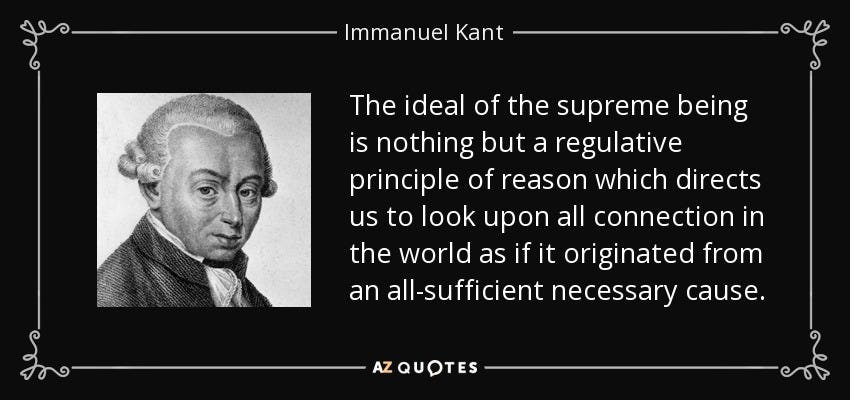
Then I would ask the following: if our causal principles emerge merely from habit, what gave rise to those habits in the first place? Even that process would appear to presuppose some underlying cause. And to Kant I would ask: if things-in-themselves are truly unknowable, by what justification can one claim that they are exempt from the PSR? As for Russell’s “that’s all” or Wittgenstein’s invitation to stop asking “why” questions, these strike me less as serious philosophical arguments than as a more sophisticated version of the physicist’s “shut up and calculate” attitude.
The claim that a physical event could be entirely causeless strikes me as deeply implausible. Yet, in essence, this is precisely the kind of move one finds in certain interpretations of quantum mechanics that allow genuinely probabilistic events or facts without deeper deterministic causes. A point of view that is to a considerable extent accepted among physicists and philosophers of science.
The relationship between the PSR and quantum mechanics is philosophically controversial because standard quantum mechanics appears to allow events that are fundamentally probabilistic rather than fully determined by prior causes. In classical physics, the PSR fits naturally: if one knows the complete state of a system and the laws governing it, the future evolution is fully determined. Quantum mechanics changes this picture. The wavefunction evolves deterministically through the Schrödinger equation, but measurement outcomes are governed by the Born Rule, which assigns only probabilities to different results. For example, the exact moment at which a radioactive atom decays appears, in standard interpretations, to have no further sufficient cause beyond probabilistic law itself. There are no “hidden variables.”
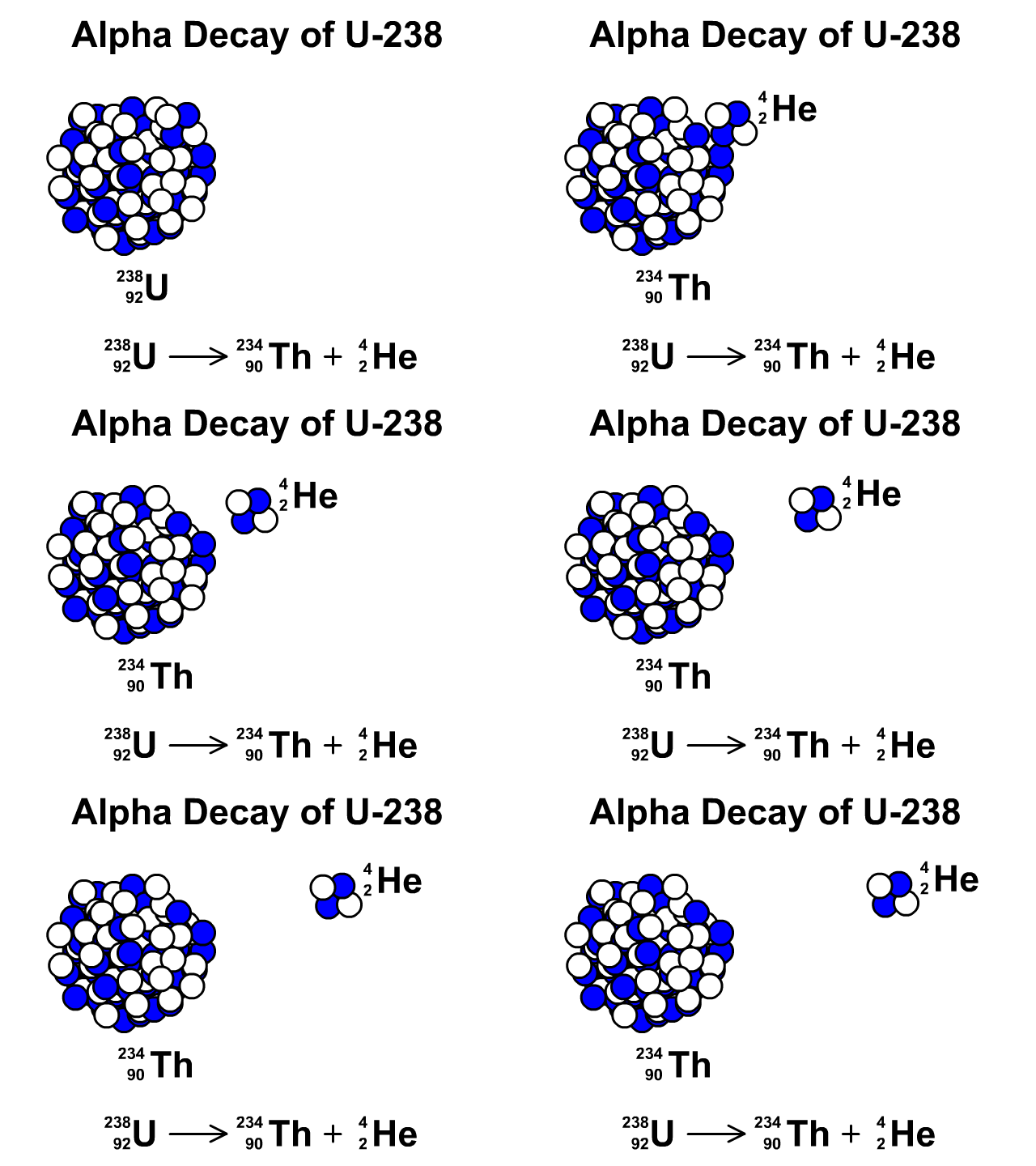
This has led many philosophers and physicists to argue that quantum mechanics weakens or even falsifies the PSR. On the orthodox Copenhagen-style view associated especially with Niels Bohr, Nature may contain genuinely irreducible “randomness” (whatever that might mean). In that case, events may occur lawfully yet without a determining sufficient reason and cause. Quantum events appear fundamentally probabilistic in the stronger ontological sense rather than fully determined by prior sufficient causes.
The only light at the end of the tunnel I can see lies in Schopenhauer’s idea that the “Will” underlying the world, and thus the will manifest in Nature or, ultimately, the Will of God, is something that does not itself require a cause. In fact, I am more inclined to conceive of it as a “self-causing” reality: if nothing exists outside of it, then there can be nothing external to it that causes it to do or become something other than itself.
This was what Baruch Spinoza defined as causa sui (“cause of itself”). For Spinoza, only the one infinite Substance, namely God or Nature, is truly self-causing, since everything else exists and acts only through and within it. An apparent absurdity that prompted Friedrich Nietzsche to declare that “the causa sui is the best self-contradiction that has been conceived so far; it is a sort of rape and perversion of logic.” It is, in his words, the “Baron Munchausen audacity of attempting to pull oneself up into existence by the hair, out of the swamps of nothingness.”
But Nietzsche objected to this self-contradictory notion because he approached it primarily through the lens of the analytic intellect. Yet, intuitively, it makes far more sense to me than claiming that there is simply no reason why an event occurred at time T1 rather than T2, or why a particle appears at position x1 rather than x2 merely because of some fundamentally “random” occurrence. The term “random” is useful as a statistical and epistemic concept, but from a deeper ontological perspective it explains nothing. It merely labels our inability to identify a deeper ordering principle or sufficient reason underlying the event.
We can also invert the reasoning and ask why anything should have a cause at all. After all, we are born into a reality in which the principles of cause and effect are simply given in everyday experience. In that sense, our commitment to causality may itself reflect an anthropocentric way of interpreting reality. Why should everything necessarily have a reason or a cause? One could imagine, at least hypothetically, a parallel universe inhabited by beings whose world is governed by events that simply emerge out of nothingness, without causes or reasons, and for whom such a state of affairs would appear entirely normal. Perhaps my rational mind isn’t flexible enough to transcend itself. Perhaps. But something about that feels fundamentally wrong to me.
Bertrand Russell rejected the need for the universe as a whole to have an explanation, famously saying: “The universe is just there, and that’s all.”
This reminds me of the comment of American transcendentalist philosophy Margaret Fuller: "I accept the universe!!"
To which British playwright George Bernard Shaw replied, "By God, she'd better!!"
Hmmm....
Let's see:
What is the reason I read this post at this exact moment?
Why did Jan just send me, at the moment before I clicked to see this post, the schedule for the Dzogchen/Buddhist retreat we're starting tonight?
Why is my cat licking her front paw (left one)?
Why do I have a sudden desire to munch on some mozzarella cheese?
Why is the Iran war not happening and happening at the same time (Schrodinger's war!!)
What do the birds return to Capistrano?
Why didn't Shankara teach an integral evolutionary philosophy (Oh wait, that's an easy one)
All of which is to say, I doubt there's a reason for anything, but I have full faith in the infinite intelligence underlying all.